
Looking Back: Aikikai Serbia Summer School 2025
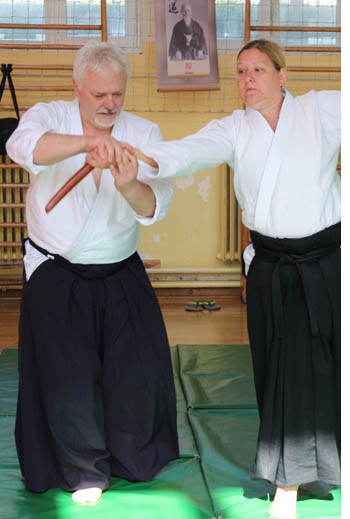
I cannot believe that almost a year has passed since the 24th Aikikai Serbia Summer School.
On reflection, my teaching sessions focused on reconnecting fundamental aikido principles with a deeper layer of internal practice, reflecting the changes in my own practice due to health reasons. This context strongly influenced both the structure and the intention behind my classes: I aimed to explore essentials and try to understand what makes a technique alive.
Across five sessions, I introduced a conceptual framework that approached aikido technique as a kind of “recipe.” This was not meant as a rigid formula, but as a pedagogical tool to help introduce that every technique emerges from the interaction of several core elements. Each day, we explored one of these “ingredients,” hoping to gradually build a more complete understanding. The context and interpretation of “ingredients” is purely subjective, and it is perfectly reasonable for others to have different views and interpretations.
We began with movement as the foundational element—the “protein” of aikido. Through tai sabaki and irimi-tenkan, the focus was on rebuilding a reliable movement vocabulary. I emphasized repetition not as a mechanical habit, but as a way of enriching what I described as a personal “data bank” of movement possibilities, building muscle memory with the goal of making movement available without conscious effort, while maintaining sensitivity and adaptability.
From there, we examined getting off the line of attack as an essential component, the “lipids” of aikido. Although lipids have a bad reputation in nutritional contexts, they are essential components of cell membranes and building blocks of life. Therefore, getting out of the line is framed as life beyond technique, something that must exist before any form or technique can emerge. The work centered on timing, positioning, and removing unnecessary resistance when facing uke.
The next layer was connection to uke’s center, which I described as the “carbohydrates,” the energy source of technique. Here, we worked on maintaining continuity through contact, avoiding local manipulation (hands and arms only), and instead organizing movement through the connection of two centers. This shifted attention from doing techniques to sustaining relationships within movement.
We then explored internal power, the “fibre” of aikido, not as something added, but as something integrated and revealed when alignment, breath, and intent are coordinated. Through kokyu-based exercises, the aim was to experience how power can emerge without visible effort, and how excessive muscular engagement disrupts this process.
The classes also addressed strength, the “salt” of aikido. I used the analogy of salt to illustrate proportion and refinement. Strength should be present in a technique but barely noticeable, like salt adding taste to food; adding too much salt becomes overwhelming and causes other subtle flavours to be lost.
Finally, hand movements were considered as spices. These should serve as subtle directional tools rather than primary drivers; they should not replace body movement or getting out of the line of attack. I believe that heavy reliance on the hands should be avoided; instead, whole-body organization should lead.
Throughout the seminar, I deliberately revealed each element progressively rather than presenting the full model upfront. I hoped this created a sense of discovery and allowed students to engage more directly with each principle before integrating them. By the final sessions, participants were encouraged to see technique not as a sequence to reproduce, but as a dynamic balance of these interacting components.
From my perspective, this approach was also a personal exploration. After time away from the mat, I found it necessary to question assumptions, strip away excess, and rely on clarity rather than habit. Teaching in this way allowed me to align my own recovery process with sharing my experiences with the seminar participants.
Overall, the seminar became less about demonstrating techniques and more about investigating what makes technique work. I wonder if the “recipe” metaphor proved useful not as an explanation of aikido, but as a way to open discussion, challenge habits, and invite a more conscious and economical practice.
Overall, it was a great experience, and I look forward to our shared time on the mat this year.